
Equipment Protection Guide
Blackmagic URSA Cine Immersive Cases
This is a camera whose two lenses are factory-calibrated to each other down to embedded positional metadata — transport it wrong once and you are not fixing it in the field. Here is how the URSA Cine Immersive travels, with 3 builds we already cut foam for.
- Dual 8160×7200 sensors
- Fixed stereo lens pair
- Apple Immersive Video
- 3 case builds
About this equipment
The Blackmagic URSA Cine Immersive is a stereo 3D cinema camera built to shoot Apple Immersive Video for the Apple Vision Pro: two fixed lenses feeding two sensors, each recording 8160×7200 with pixel-level synchronization and 16 stops of dynamic range into a single Blackmagic RAW file. The lens system's positional calibration is embedded as metadata that travels through post — the geometry of those two lenses relative to each other is, functionally, part of the recording format.
That is what makes transport different from any other URSA. The stereo pair cannot be removed and cannot be knocked out of alignment without consequences downstream, so the camera has to travel as a calibrated instrument: a purpose-cut cavity supporting the body's magnesium chassis, the lens pair unloaded and untouched, batteries and media in their own pockets. The builds below — including a Pelican 1637 layout — are cut exactly that way.
Choose protection by workflow
Occasional moves, vehicle transport: foam inserts and padded protection in a case you own.
Travel and carry-on workflows: compact hard-shell builds sized to airline limits.
Constant shipping: ATA shells, modular replaceable foam, fleet-matched layouts.
Purpose-built around your exact package and workflow.
Start a custom project →Cases built for this equipment
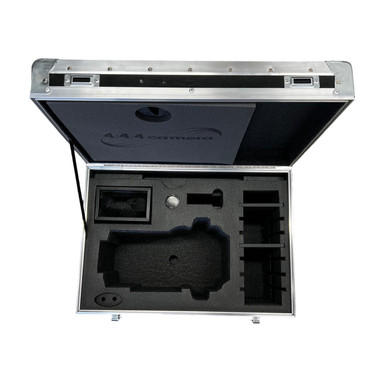
Blackmagic URSA Cine Immersive Camera Case — Body, Rods & Dovetail, ATA 300
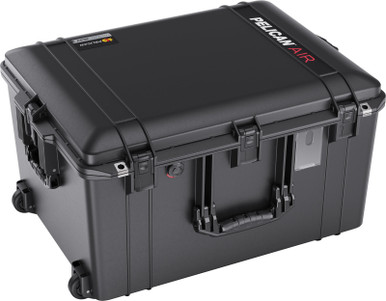
Blackmagic URSA Cine Immersive Camera Case — Body, One Media Module, Rods & Accessory Tray, Pelican Air 1637
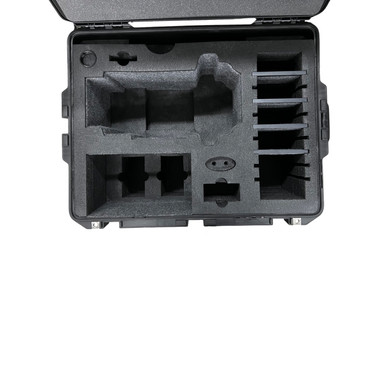
Blackmagic URSA Cine Immersive Camera Case — Mid49 Base & Top Handle On, Two Media Modules, Pelican Air 1637
Transport knowledge
On most cameras a lens knock costs you a lens. Here the two fixed lenses are calibrated to each other with metadata embedded in every frame — an alignment problem contaminates the footage, not just the glass. The camera never ships in generic padding; the cavity is cut to support body and lens housing together.
B-mount batteries, media, power supply, and the cabling for a 2×8K data pipeline. Lithium batteries stay accessible for airline carry-on rules; media gets its own pocket so a $30K camera and its footage never share a failure.
180-degree capture wants real locations — which means docks, flights, and vehicle transfers for a camera that behaves like a scientific instrument. A rigid shell with engineered foam is the baseline, not the upgrade.
Where to buy the equipment
Some links above are affiliate links — Innerspace may earn a commission at no additional cost to you.
Frequently asked questions
Yes — the layout is engineered around the fixed stereo pair, which is not designed to be removed. The cavity supports the body and lens housing so no impact load paths run through the optics.
Yes — B-mount batteries and media get their own cavities, with batteries positioned for quick removal to your carry-on when flying. Tell us your power and media loadout and we cut for it.
Builds shown here are made to order and typically ship in 14–21 business days. New layouts are quoted per project.
Related equipment
Equipment context referenced from: Film and Digital Times — Blackmagic URSA Cine Immersive Camera. Case and foam guidance is Innerspace Cases’ own.
Multi-unit and matched case sets are what we build best — one engineered layout, every case identical, re-orderable for years.
Start a fleet quote